There’s one segment of real estate that doesn’t slow down just because the market shifts.
Relocation.
Whether it’s a job transfer, a corporate mandate, a cost-of-living adjustment, or a lifestyle change, people who relocate have to move. It’s not always optional. And that’s what makes this niche so powerful.
In many markets, relocation accounts for a huge portion of transactions — often close to 40%. But here’s the catch:
Relocation clients don’t need just an agent.
They need a guide.
Let’s break down how to win in this space in 2026.
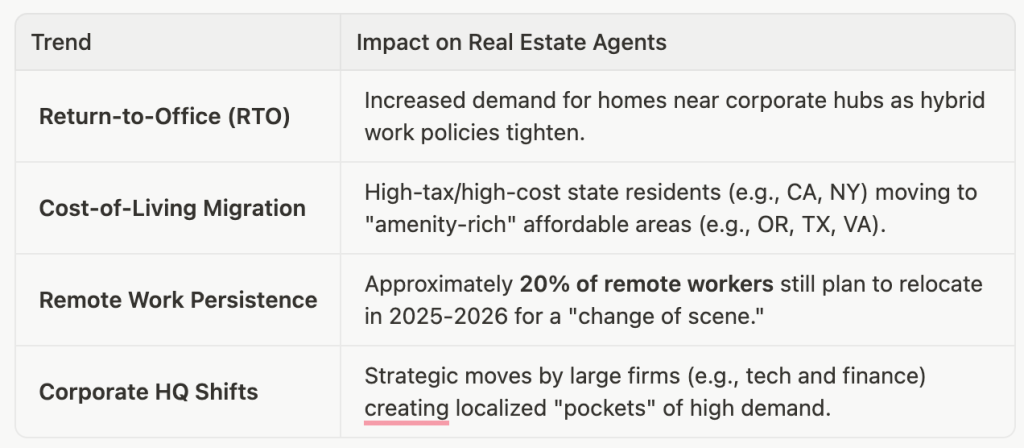
Key Trends
The Relocation Market Has Changed
In the early 2020s, a lot of moves were lifestyle-driven. People wanted sunshine, lower taxes, or remote-work flexibility.
Now, we’re seeing more necessity-based moves.
- Corporate return-to-office policies
- Internal company transfers
- Promotions requiring relocation
- Cost-of-living shifts
- Family obligations
These buyers and sellers are decisive. They don’t casually browse for a year.
But they also rely heavily on local expertise because they don’t know the area.
That’s your opportunity.
Position Yourself as a “Community Concierge”
Relocation marketing isn’t about pushing listings.
It’s about reducing uncertainty.
When someone moves across the country, they’re thinking about:
- Schools
- Commutes
- Taxes
- Safety
- Lifestyle
- Grocery stores
- Coffee shops
- Weather
- Traffic
If your marketing only talks about bedrooms and square footage, you’re missing the point.
You need to become the bridge between “unknown city” and “future home.”
Digital Strategies That Actually Work
1. Own the “Moving To” Searches
Your website, social profiles, and LinkedIn headline should clearly say something like:
- “Relocation Specialist in [City]”
- “Helping Families Move to [City] with Confidence”
Create content around:
- “Moving to [City] – What You Need to Know”
- “Pros and Cons of Living in [Neighborhood]”
- “Cost of Living: [City A] vs [City B]”
- “Best Areas for Families in [City]”
YouTube is especially powerful here. Out-of-town buyers search YouTube like a local news station.
Walk neighborhoods.
Drive commutes.
Compare price ranges.
Be real and transparent.
That builds trust before they ever contact you.
2. Leverage LinkedIn (Where Relocation Often Starts)
Relocation conversations often begin at work.
Which means they begin on LinkedIn.
Make sure your profile clearly communicates that you specialize in helping out-of-town buyers.
Post about:
- Local market updates
- Corporate relocation tips
- School district breakdowns
- Tax differences
- Lifestyle insights
And don’t just post.
Connect with:
- HR managers
- Corporate recruiters
- Team leads
- Local hiring managers
That’s where referral opportunities begin.
Working with Relocation Companies (The Good and the Tough)
Relocation Management Companies (RMCs) handle corporate transfers.
The upside?
Steady lead flow.
The downside?
Referral fees can range from 40% to 50% of your commission.
Many require certifications and proof that you’re a top producer.
For some agents, it’s worth it.
Others use RMCs strategically — not just for immediate income, but to build long-term relationships that lead to future referrals outside the fee structure.
It’s a long game.
An Out-of-the-Box Strategy: The Airbnb Play
Here’s something most agents aren’t doing.
Partner with Airbnb hosts — especially higher-end or extended-stay rentals.
Why?
Because many relocating professionals stay in short-term rentals while house hunting.
You can:
- Create a beautiful, non-salesy “Insider’s Guide to [City]”
- Include favorite neighborhoods, restaurants, parks, and schools
- Add a QR code inside the rental linking to the guide
- Softly invite readers to a relocation resource page on your website
It’s subtle.
It’s helpful.
And it reaches people before they even start interviewing agents.
Best Practices That Separate the Pros
1. Lead with Empathy
Relocation is stressful. People are juggling jobs, kids, timelines, and uncertainty. Be calm. Be reassuring.
2. Respond Fast
Relocating clients operate on tight schedules. If you respond in 24 hours, you might lose them. Speed matters.
3. Be Hyper-Local
Know:
- School ratings
- HOA details
- Commute times at rush hour
- Where locals actually hang out
- Which neighborhoods flood
- Which ones are quiet at night
Google-level knowledge isn’t enough. They want insider insight.
4. Provide a Clear Timeline
Give them a relocation checklist:
- Week-by-week tasks
- Inspection timeline
- Utility setup
- Closing process
- School registration steps
Organization builds confidence.
Why Relocation Is a Resilient Niche
Local markets rise and fall.
But job transfers, promotions, and life changes continue.
When you build a strong relocation brand — through SEO, LinkedIn, YouTube, partnerships, and corporate connections — you create a business model that isn’t fully dependent on local lead flow.
You become the go-to guide for people who don’t know anyone else in town.
And that’s powerful.
Final Thoughts
Relocation marketing in 2026 is about blending high-tech and high-touch.
Use:
- Virtual tours
- Video content
- Digital relocation guides
- LinkedIn networking
But back it up with:
- Local expertise
- Responsiveness
- Empathy
- Clear communication
Because when someone moves to a new city, they’re not just buying a house.
They’re choosing a new life.
And the agent who makes that transition feel safe and smooth?
Wins the business — and often, the referrals that follow.