Skip to content Skip to footer

If you’re buying rental property based purely on “this feels like a good deal,” we need to talk.

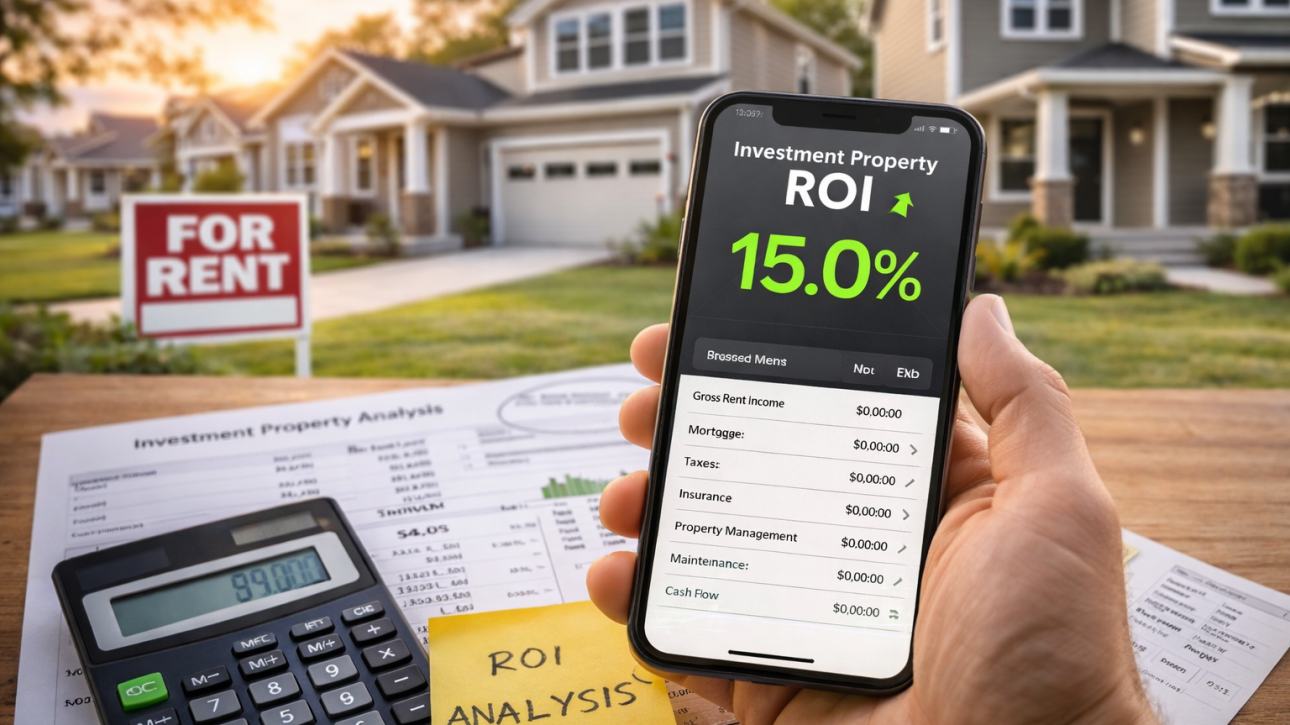
Investment property isn’t about granite countertops or pretty curb appeal. It’s about numbers. Specifically: ROI — Return on Investment. And once you understand how to analyze ROI correctly, you’ll stop guessing and start investing with confidence.

Let’s break this down in real-world terms.


What ROI Actually Means

ROI is simply how much money your property makes compared to how much money you put into it.

If you invest $50,000 into a deal and it produces $10,000 per year in profit, that’s a 20% annual ROI. Simple math. Powerful insight.

But here’s where most investors go wrong: they only look at rent.

ROI is more than rent minus mortgage.


The Numbers You Really Need to Track

To analyze a property properly, you need to calculate:

1. Purchase Costs

  • Down payment
  • Closing costs
  • Rehab or renovations
  • Furnishing (if short-term rental)

2. Ongoing Expenses

  • Mortgage
  • Property taxes
  • Insurance
  • Maintenance
  • Property management
  • Vacancy allowance
  • HOA (if applicable)

3. Income Sources

  • Monthly rent
  • Short-term rental revenue
  • Other income (parking, laundry, storage, etc.)

Once you subtract expenses from income, you get your net cash flow. That’s the real story.


Cash-on-Cash Return (The Metric Investors Love)

One of the most useful ROI metrics is cash-on-cash return.

This looks at how much actual cash you invested versus how much cash the property produces annually.

Example:

  • You invest $60,000 out of pocket.
  • The property produces $9,000 per year in cash flow.

That’s a 15% cash-on-cash return.

This metric is especially important if you’re leveraging financing, because it shows how efficiently your money is working.


Don’t Forget Appreciation & Tax Benefits

Cash flow is important, but it’s not the only return.

Long-term wealth often comes from:

  • Property appreciation
  • Mortgage paydown (tenants building your equity)
  • Depreciation tax benefits

When you factor those in, your total ROI can be significantly higher than your cash flow alone suggests.


Short-Term vs Long-Term Rental ROI

If you’re comparing long-term rentals to vacation or short-term rentals, your analysis changes.

Short-term rentals may generate:

  • Higher gross income
  • Higher management costs
  • More seasonal variability

Long-term rentals typically provide:

  • More stability
  • Lower management involvement
  • Predictable cash flow

The “better” option depends on your goals — income now or stability long term.


Why Most Investors Lose Money

It’s usually one of three things:

  1. Underestimating expenses
  2. Overestimating rent
  3. Ignoring vacancy and repairs

Conservative numbers win. Optimistic projections lose.


Final Thought

The best investors don’t fall in love with properties.
They fall in love with solid returns.

Before you buy your next investment property, run the numbers honestly. If it doesn’t hit your target ROI, move on.

There’s always another deal.

And when you build your business around disciplined ROI analysis instead of emotion, that’s when investing starts to feel predictable — and profitable.

R. Roborts

105 articles published

Investment Property ROI Analysis (Without the Boring Spreadsheet Headache)

If you’re buying rental property based purely on “this feels like a good deal,” we need to talk. Investment property isn’t about granite countertops or pretty curb appeal. It’s about numbers. Specifically: ROI — Return on Investment. And once you understand how to analyze ROI correctly, you’ll stop guessing and start investing with confidence. Let’s…

Read More

Vacation Home & Short-Term Rental Marketing: How to Stand Out in a Crowded Market

Owning a vacation home or short-term rental can be incredibly profitable. But here’s the truth most people don’t talk about: Buying the property is the easy part. Marketing it is where the money is made. With platforms like Airbnb and VRBO flooded with listings, simply putting your property online isn’t enough anymore. If you want…

Read More

New Construction Marketing for Builders: How to Sell Homes Before They’re Even Finished

Selling new construction isn’t the same as listing a resale home. You’re not just marketing a house — you’re marketing a vision. There’s no lived-in charm. No staged memories. Sometimes not even drywall. So your marketing has to do one thing really well: Help buyers emotionally see themselves in something that doesn’t fully exist yet.…

Read More

Military Relocation Specialist (MRP) Marketing: How to Win Military Clients the Right Way

If you’re a real estate agent looking for a niche that’s consistent, loyal, and referral-driven, working with military families might be one of the best decisions you can make. But here’s the truth: You can’t market to military clients the same way you market to everyone else. If you’re serious about serving this community, becoming…

Read More

How to Use Pinterest to Generate Home Decor & Staging Leads (And Why It’s a Gold Mine You’re Probably Ignoring)

Let me be honest with you: if you're a home stager, interior designer, or real estate professional and you're not on Pinterest, you're leaving serious money on the table. Not maybe-money. Real, qualified, ready-to-hire-you money. I know, I know — you've heard this before about every platform. But Pinterest is genuinely different, and here's why:…

Read More

The Data Behind Real Estate Podcasting Shows… It’s More Powerful Than You Think

If you’ve ever thought about starting a real estate podcast, you’ve probably asked yourself: “Is anyone actually listening to these?” Fair question. There are a lot of podcasts out there. But when you look at the data behind podcasting — especially in niche industries like real estate — something interesting happens. It’s not about going…

Read More

Home Valuation Lead Magnets: The Smart Way to Turn Curiosity Into Clients

If you’ve been in real estate for more than five minutes, you know this is one of the most common questions homeowners ask: “How much is my home worth?” It’s natural. Home values are constantly changing. People hear about neighbors selling. They see headlines about interest rates. They start wondering what their biggest asset might…

Read More