If you’ve ever spent hours manually hunting For Sale By Owner listings on Zillow or Redfin, you already know the pain. You find a promising property, try to track down the owner’s contact info, fire off a generic email, and wait. Rinse and repeat — endlessly. It’s exhausting, and frankly, it doesn’t scale.
But what if the whole process ran itself while you slept? In this post, I’m going to walk you through exactly how to build an automated FSBO lead generation system that scrapes listings, finds owner contact info, scores leads with AI, and drops warm prospects directly into your calling queue — all without manual intervention.
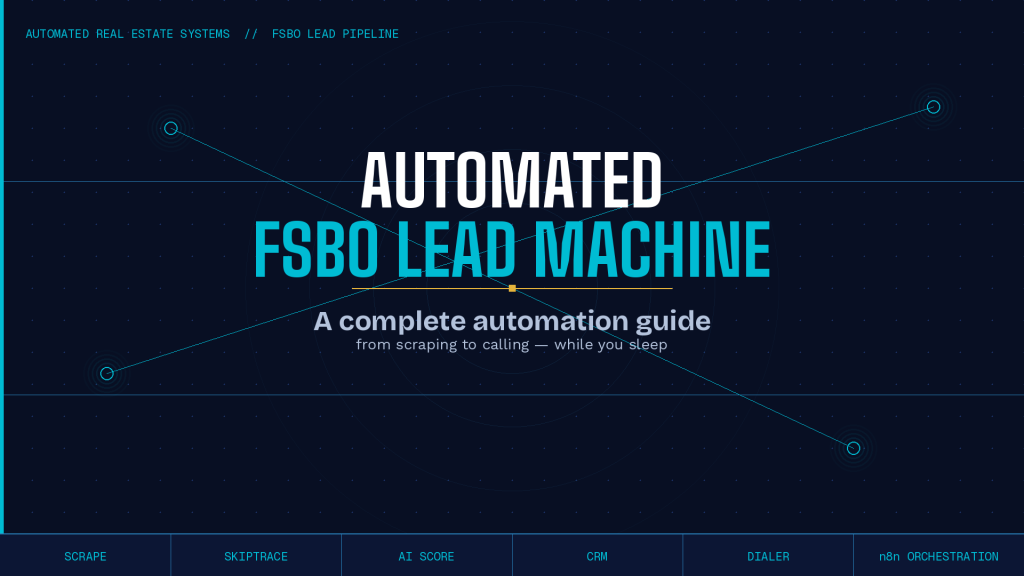
Here’s the tech stack we’re working with: n8n for orchestration, Python scrapers for Zillow and Redfin, a skiptracing service to find contact details, GoHighLevel as our CRM and marketing hub, BatchDialer for outbound calls, and Abacus.ai for AI-powered lead scoring. Let’s dig in.
Step 1: Getting the Listings — The Scraping Problem
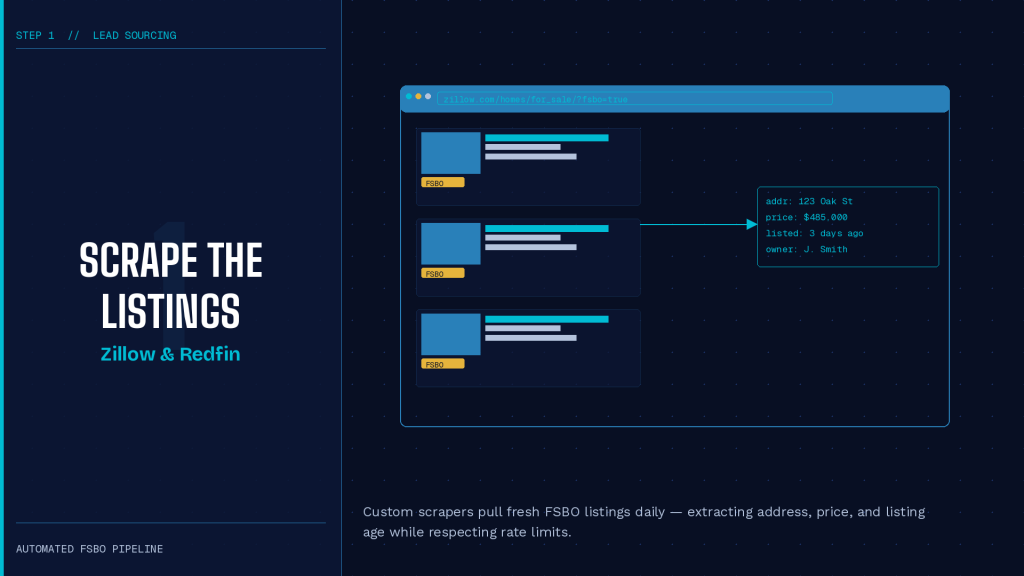
Here’s the first thing you need to know: Zillow and Redfin don’t have public APIs for FSBO data. They’re protective of that information, and for good reason — it’s valuable. That means if you want to pull listings programmatically, you’re going to need to scrape.
There are a few approaches to this:
- Build your own scraper using Python libraries like BeautifulSoup or Scrapy. It’s the most flexible option, but requires maintenance as site structures change.
- Use a managed scraping service like Apify, ScrapeHero, or Datablist. These handle the headaches of rotating proxies and user-agent spoofing for you.
- Combine both — custom logic with a proxy service underneath it.
One thing I want to be clear about: always respect robots.txt and terms of service. Scraping ethically isn’t just about staying out of legal trouble — it’s about building something sustainable. Use rotating proxies, throttle your requests, and don’t hammer their servers.
From each listing, you’ll want to pull property address, listing price, description, any visible contact details, and the date it was listed. That last one matters — fresh FSBOs are more likely to be open to outreach than listings that have been sitting for months.
Step 2: Skiptracing — Finding the Human Behind the Listing
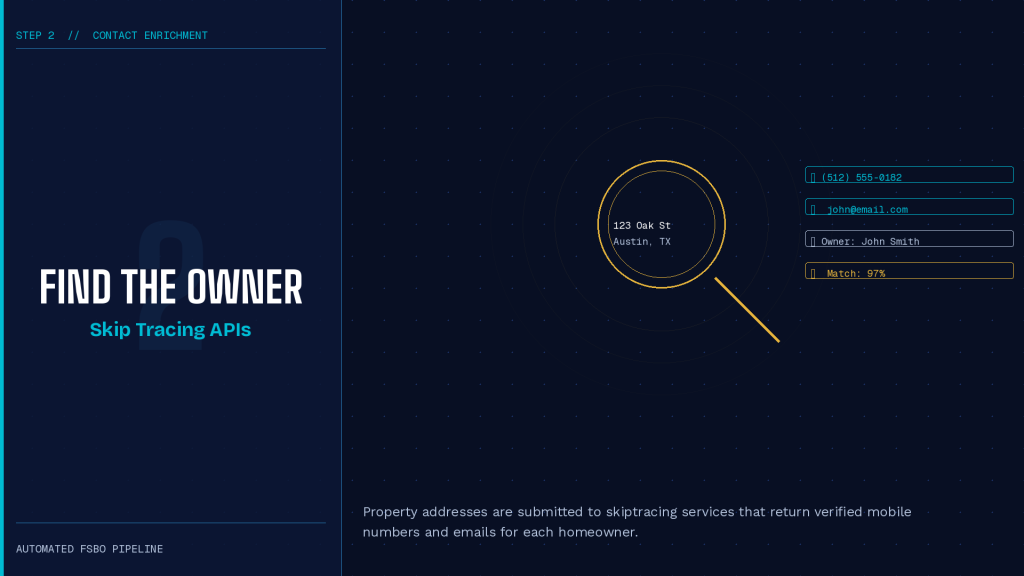
You’ve got a list of properties. Now what? Most FSBO listings don’t include the owner’s phone number or email — at least not one that goes anywhere useful. This is where skiptracing comes in.
Skiptracing is basically reverse-lookup on steroids. You feed in a property address, and the service returns owner contact information — mobile numbers, email addresses, sometimes multiple options. Services like BatchSkipTracing, REI Skip, and Tracerfy all offer APIs that plug directly into an automation workflow.
What you’re looking for in a good skiptracing service: high accuracy rates (bad phone numbers are worse than no numbers — they waste your dialer time), batch processing capability so you’re not submitting addresses one by one, and reasonable API pricing at scale.
Once skiptracing runs, you’ve transformed a raw listing into an actionable lead with real contact details. That’s where the magic starts.
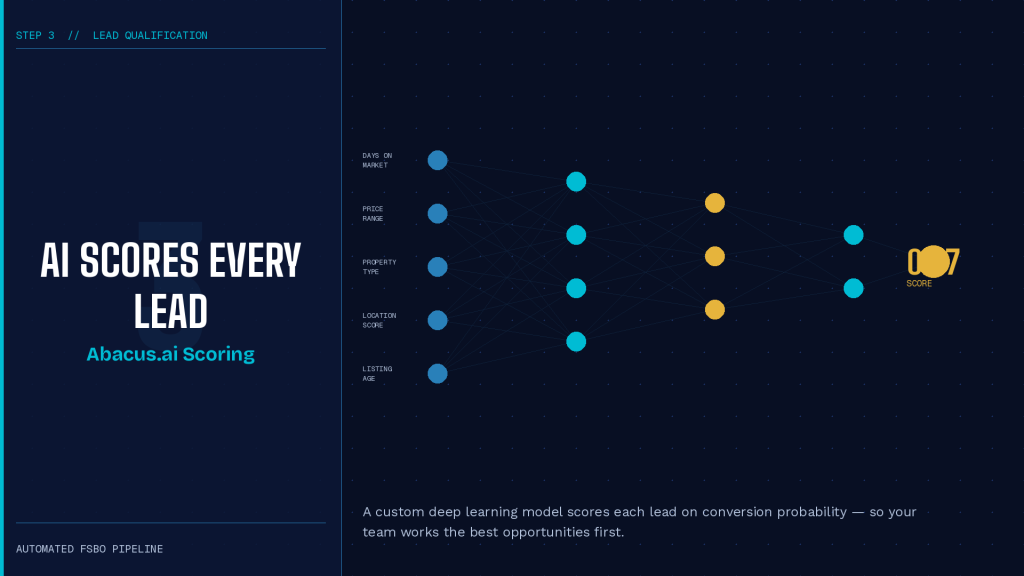
Step 3: AI Lead Scoring with Abacus.ai
Not all FSBO leads are created equal. Some homeowners are motivated and ready to talk. Others listed months ago, set an unrealistic price, and are going nowhere. Before you spend dialer minutes and agent time on a lead, it helps to know which bucket they’re in.
This is where Abacus.ai earns its place in the stack. You can train a custom deep learning model on your historical conversion data — which FSBO leads ultimately became clients, and what those leads looked like at the time of contact. Once trained, you can hit the scoring API with each new lead and get back a conversion probability score.
Inputs to the model might include days on market, listing price vs. estimated value, property type, location, and any behavioral signals you’ve collected. Over time, as you feed it more outcome data, the model gets sharper.
High-scoring leads go straight to the calling queue. Medium scores get dropped into an email/SMS nurture sequence. Low scores get tagged and revisited later, or filtered out entirely. You’re no longer treating every lead the same — you’re working smarter.
Step 4: GoHighLevel — Your CRM and Nurture Engine
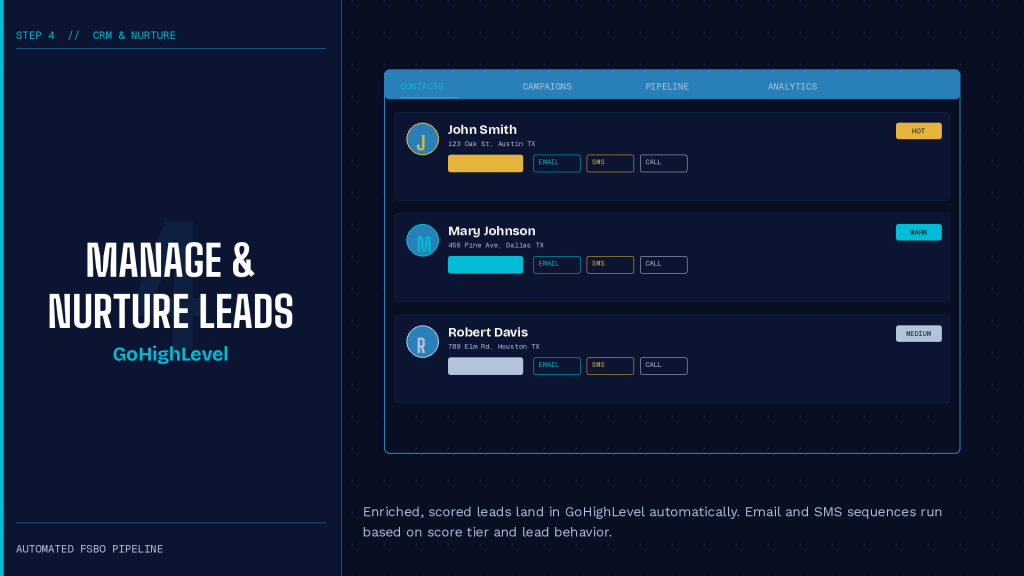
GoHighLevel (GHL) is where your leads live. Once a lead comes through scraping and skiptracing, enriched with contact details and an AI score, it gets imported into GHL automatically via its API.
From there, GHL takes over on the nurture side. Leads who aren’t quite ready for a call get dropped into an automated email and SMS sequence — personalized by property type, location, or score tier. GHL’s workflow builder lets you set triggers based on lead behavior: if they open an email, escalate them; if they click a link, flag them for immediate callback.
Everything is tracked in one place. Contact history, property details, campaign status, lead stage — all of it visible to anyone on your team. No more leads falling through the cracks because someone forgot to follow up.
Step 5: BatchDialer — Getting Your Agents on the Phone
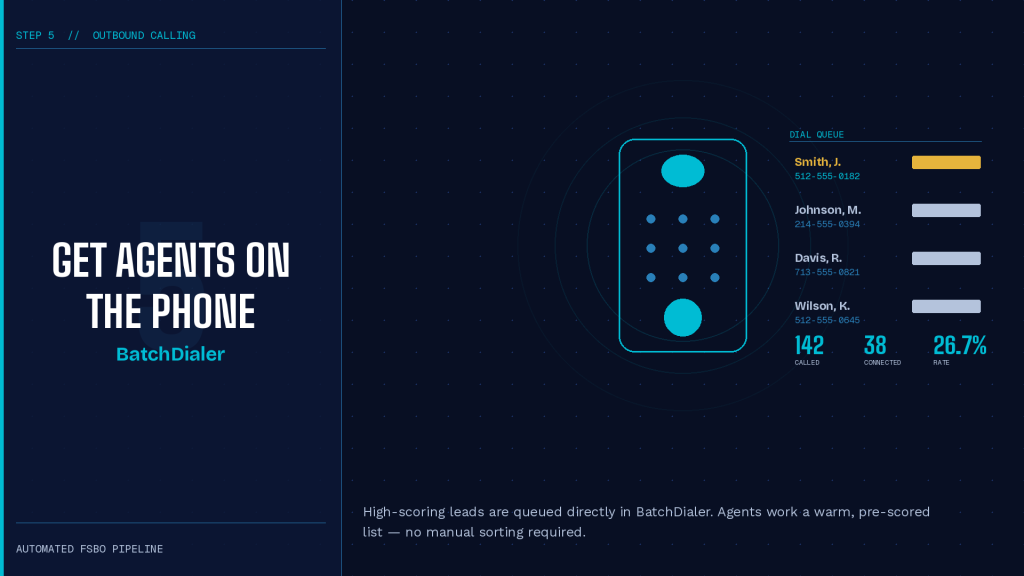
Once a lead hits a certain score threshold or responds to a nurture touchpoint, they get pushed into BatchDialer. BatchDialer is a power dialer — it handles the mechanics of high-volume outbound calling so your agents can focus on conversations, not dialing.
Via the BatchDialer API, n8n queues leads into the right calling campaign automatically. Call outcomes get logged and can be written back to GoHighLevel, keeping your CRM current without any manual data entry.
The result: agents show up to their shift with a warm queue of pre-scored, pre-nurtured leads. No cold lists. No digging through spreadsheets. Just conversations.
The Glue: n8n Running on a Hostinger VPS
All of these tools are powerful on their own. n8n is what connects them. It’s an open-source workflow automation platform — think Zapier, but self-hosted and far more flexible for complex logic.
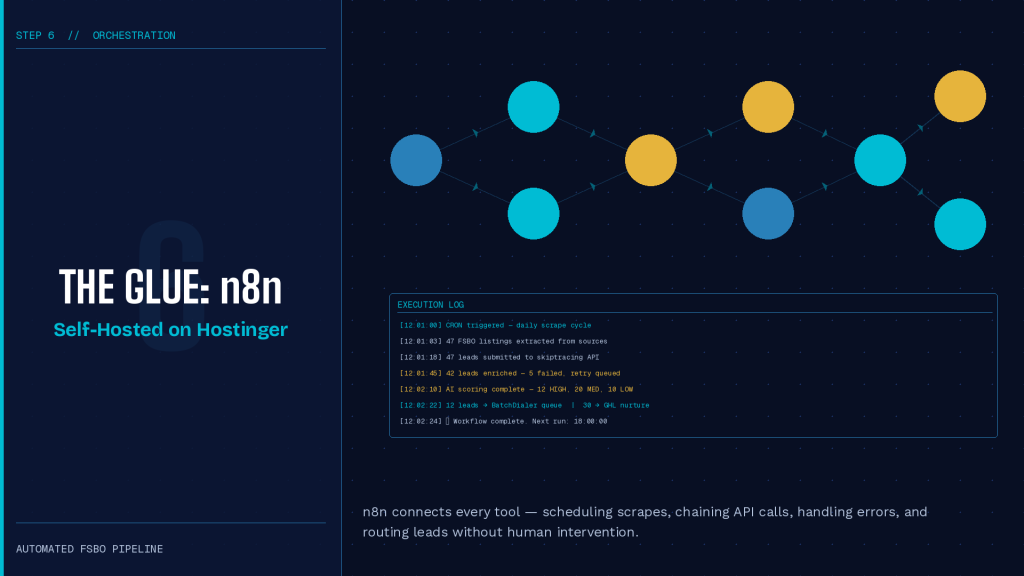
Hosting n8n on a Hostinger VPS gives you full control, no per-execution pricing caps, and the ability to run long-running workflows without hitting timeouts. You can schedule scraping runs with Cron nodes, trigger actions from GoHighLevel webhooks, and chain together API calls with error handling and retry logic.
A simplified version of the workflow looks like this: a scheduled Cron node triggers the scraper, new listings get passed to the skiptracing API, enriched data goes to Abacus.ai for scoring, the scored lead gets imported to GoHighLevel, and depending on the score, either a nurture sequence fires or the lead gets queued in BatchDialer.
Every step has error handling. If a skiptracing call fails, n8n logs it and retries. If GoHighLevel returns an error, you get a Slack notification. The system stays transparent.
Things to Keep in Mind Before You Build This
A few practical considerations if you’re planning to implement this:
- API rate limits are real. Every service has them. Build delays and batching into your n8n workflows from day one, or you’ll hit walls at the worst moments.
- Data quality matters more than data volume. Validate phone numbers and email formats before they enter your CRM. Garbage in, garbage out.
- Compliance is non-negotiable. TCPA governs how and when you can call or text people. CAN-SPAM applies to your email outreach. These aren’t optional — understand them before you launch.
- Watch your costs. Skiptracing, Abacus.ai, and BatchDialer all charge per use at scale. Set up usage monitoring so you don’t get a surprise invoice.
- Build for scale from the start. Design your n8n workflows to handle 10x your initial lead volume. It’s much easier than retrofitting later.
Final Thoughts
This isn’t a simple afternoon project — there’s real technical work in getting all these pieces to talk to each other. But the payoff is a system that generates, qualifies, and warms up FSBO leads around the clock, with minimal ongoing human input.
If you’re a real estate professional serious about scaling your FSBO outreach, this kind of automation is what separates teams that are constantly chasing leads from teams that always have a full pipeline. The technology is accessible, the tools exist, and the process is repeatable.
Start with one piece — maybe just scraping and skiptracing — and add layers as you go. You don’t have to build the whole machine at once.